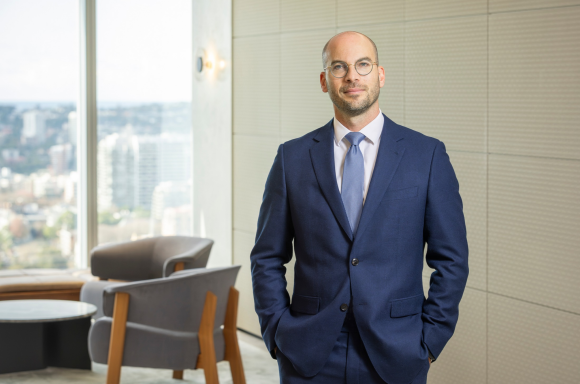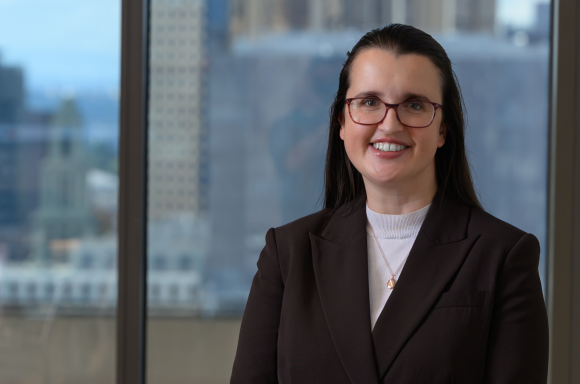
Michael Repse is a newly appointed partner in our property & development practice. He advises on a diverse range of residential, commercial, retail, industrial and mixed-use developments throughout Australia. His clients include public and private clients, encompassing major Australian and international property developers, financial and educational institutions, professional consultants on front-end construction law.
We spoke to Michael about the resilience of the construction and development sector in adapting to enormous challenge and change, including the impact of new technologies.
You've built your career here at ABL advising on some of Australia's most significant development and construction projects. What drew you to construction law, and what continues to make the work interesting?
The adaptability and flexibility required of people in the construction and development industry. Every industry has to be flexible enough to respond to changing circumstances, but construction is the canary in the coalmine in a lot of ways – impacted by a whole range of different market factors, fiscal policy changes, environmental issues, employment conditions, even immigration.
Construction operates at the intersection of various different sectors and, as a consequence, it has to be fleet footed. I find that aspect of the work stimulating, more real, tangible and grounded in what’s affecting the economy and communities.
The construction sector has experienced enormous change over the past decade, from supply chain disruption and cost escalation to new procurement models. What trends do you think are having the biggest impact on clients today?
It's a combination of trends, and clients are impacted differently depending on whether they’re involved in residential, commercial or mixed-use developments.
Not knowing how house prices will be affected brings a level of uncertainty to the end revenue model and forecasts for future revenue, and clients are having to come up with models and alternative structures in their feasibilities.
Another major issue has been the instability in construction costs. We have complex, unpredictable geopolitical issues around the world, obviously the Middle East but also concerns around supply out of China and how it affects logistical passageways and freight.
The cost of capital has also changed dramatically. Clients have been looking towards new funding sources and, as a result of that, we've seen developers seek more creative structures and solutions.
The industry has had to move and adapt in response to all those factors. It has to be resilient, and it is resilient because housing, development and infrastructure are always required. It's a matter of recognising and managing the ever-changing risks.
"The industry has to be resilient, and it is resilient because housing, development and infrastructure are always required. It's a matter of recognising and managing the ever-changing risks."
Data centres have become one of the fastest-growing sectors in property and infrastructure. What's driving that growth, and what unique legal or commercial issues do these projects present?
The growth is driven by our increased reliance on data and the cloud centric world we live in. And we're only going to have a greater demand for more data, and secure data, which means that western countries are going to want and need more and more construction to house their data materials
In terms of the advice required for this sort of construction, there are still questions around the revenue streams and other unprecedented commercial elements. But in terms of construction itself, it's not particularly different from other sophisticated warehousing and automation facilities that are high tech and high end in terms of their infrastructure and mechanical input.
Through that lens, it's all been done before but it's definitely an emerging product that hasn't been provided at this scale before. How much of the market it takes up and the broader commercial element to it all are unfolding in real time.
Construction projects often involve balancing commercial objectives with complex stakeholder relationships. What do you think clients value most in a legal adviser when navigating major projects?
It’s that commercial lens and it’s what drew me to ABL.
Our clients value having a legal advisor who is experienced, commercial and alive to risks before they materialise.
I value working with clients who will call me before problems arise to talk through options and work solution together. That way, I feel like I'm part of their business – not only a lawyer, but a trusted participant in boardroom deliberations.