Arnold Bloch Leibler is renowned within the Australian business, legal and accounting communities as being the ‘go-to’ taxation law practice for corporate leaders, major companies and wealthy private clients. Sought out by clients to advise on high-profile taxation audits and disputes, and to provide commercial tax advice on complex transactions, our team has formidable taxation knowledge and an unrivalled reputation.
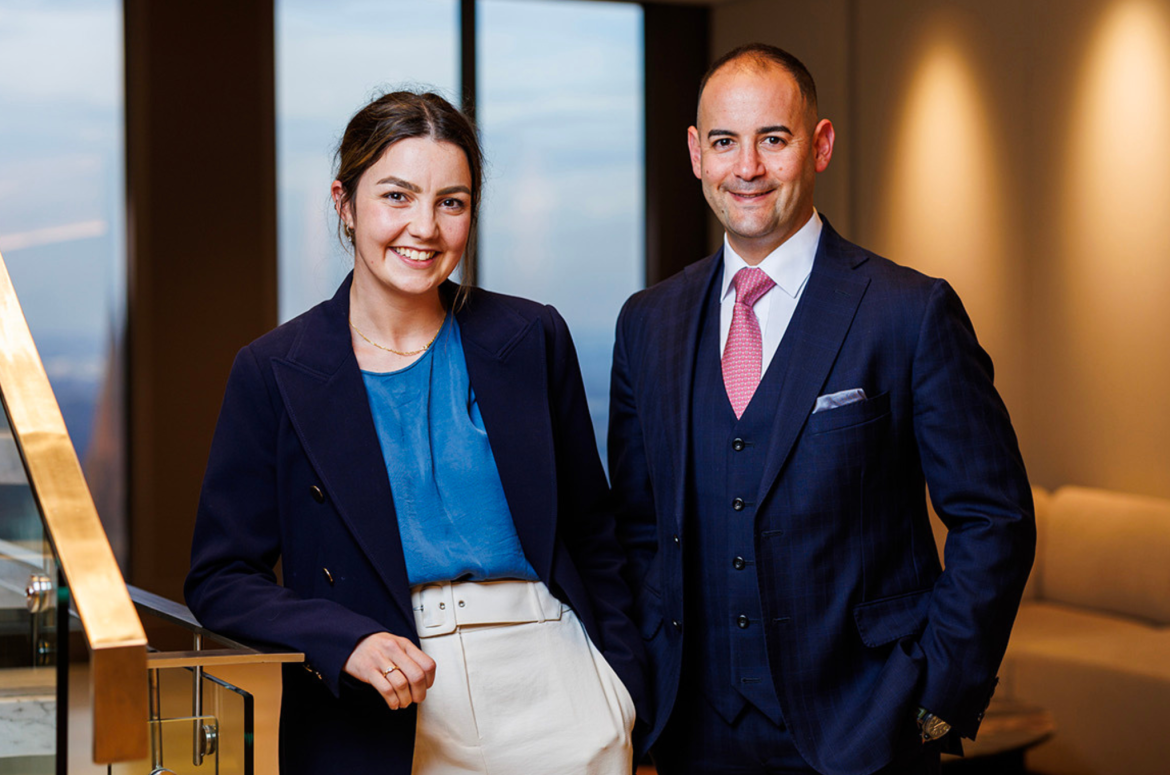
In this Q&A, partner Shaun Cartoon and lawyer Caroline Conan-Davies share their unique perspectives on the intricacies of tax law, highlighting that the area is both challenging and fascinating, with no two days being the same. They also underscore the breadth of ABL’s tax practice, which encompasses both front-end transactional work and back-end litigation, offering a comprehensive learning experience.
Tax law is often perceived as a highly technical field requiring a strong mathematical or financial background. Is this accurate?
Shaun: While that perception is understandable, it doesn't fully capture the essence of the practice. The reality is that tax law demands a different kind of aptitude; a keen ability to dissect intricate legal frameworks and apply them to a diverse range of factual scenarios. It's more about intellectual curiosity and a knack for problem-solving in the face of ambiguity.
I say tax law is like astronomy. It’s like gazing up into a random collection of stars which make no sense whatsoever, then after a year or two, a few stars will join together to make a constellation. Even after years of experience, the universe of tax law still holds uncharted territories. This constant learning and the intellectual challenge of grappling with novel issues are central to the experience, particularly at a firm like ABL, where we are consistently presented with the most complex and cutting-edge tax matters.
Caroline, you returned to ABL's Tax team after your clerkship. What were the main factors that led to that decision, and what has your experience as a junior in the team been like?
Caroline: The honest answer is that I was happiest here. It really came down to the culture. ABL was the one place where I felt I could truly be myself and in the Tax team, our individual quirks are not just accepted but encouraged.
Professionally, my experience as a junior has been incredibly enriching. Tax law, at its core, is about legal interpretation and argumentation, and it's been rewarding to see how it draws upon so many aspects of my law degree, from analysing legislation to understanding precedents. What I particularly value at ABL is the variety of work I'm exposed to as a junior. I've had the opportunity to work across different specialisations within the team, including both transactional and litigation matters, which has provided invaluable hands-on experience.
The ABL Tax team handles both transactional and litigation matters. Could you explain the distinction between these two areas of tax law?
Shaun: While most tax teams handle both transactional (front-end) and litigation (back-end) work, larger firms often lead to more specialised roles early on. At ABL, our smaller, more generalist team structure means junior lawyers gain exposure to both. This is a real strength because seeing the pitfalls and consequences in litigation makes us better transactional advisors.
For example, in our significant mid-market M&A practice, we're involved from the outset, working to structure deals tax-efficiently. Tax in these transactions is often binary and irreversible, unlike some other legal areas where amendments can fix errors. This front-end work, focused on optimal structuring, is directly informed by our experience in back-end disputes, allowing us to proactively address potential issues and ensure smoother outcomes for our clients.
"Working with lawyers at different levels is amazing, the wealth of experience they have is something you can't replicate. You learn so much by drawing on their knowledge."
The ABL Tax team encourages interaction between partners and junior lawyers. What do you both see as the benefits of this interaction?
Shaun: Having a strong team is crucial. While clients still expect partner-level input on technical matters, the volume and variety of work means I can't be as deeply "on the tools" as I was earlier in my career. I value the fresh perspectives and capacity that junior lawyers bring. Our team isn't overly hierarchical. We encourage everyone to operate at their highest potential, regardless of their title. My aim is to foster rapid growth, providing opportunities for junior lawyers to take on increasing responsibility as soon as they're ready.
Caroline: From my perspective as a junior, the opportunities for hands-on learning and early exposure have been invaluable. There's always scope to get involved by reaching out to partners and senior associates, which is fantastic. Working with lawyers at different levels is amazing, and the wealth of experience they have is something you can't replicate. You learn so much by drawing on their knowledge. At the same time, it's really empowering when a partner or senior associate asks you for the latest update on a specific area, and you're the one who knows because it's something you've recently researched. Beyond the learning, the relationships within the team are incredible. I respect my colleagues as lawyers, but they're also supportive friends who offer guidance and opportunities.
Could you tell us a bit about the team culture and why you think it's significant for your work?
Shaun: We are a very close and cohesive team, and we genuinely enjoy working with each other and the rest of the firm. But this isn't just about being friendly, it's actually a critical element for effective tax practice. Creating a team culture where everyone feels safe and empowered to voice their opinions is paramount. As a partner, when working with lawyers of any level, I actively encourage them to challenge my thinking and point out when they believe I might be wrong. I want the most junior lawyer to feel comfortable walking into my office at any time to challenge my views.
Explore our Tax expertise or learn more about legal careers at Arnold Bloch Leibler.
Quick fire questions
What's the most rewarding part of being a tax lawyer?
Shaun: Getting to work with our magnificent team.
Caroline: The variety in what I'm doing.
What’s your proudest achievement or best result for a client?
Shaun: That after 17 years of practicing law, I’m still really happy and excited by what I do.
Caroline: The Tax team works closely with the public interest team, and my proudest moment was getting my first charity registered with the Australian Charities and Not-for-profits Commission because I was able to use my skills as a commercial lawyer to help a charity pursue their purpose.