

Do you need to notify your deal to the ACCC?
Updated April 2026
The most significant change to competition laws in decades, Australia’s new “merger” laws create onerous new regulatory obligations for businesses, with severe consequences for non-compliance.
Since 1 January 2026, a wide range of business deals must now be notified to the ACCC before those deals can be put into effect. If you don’t notify when required, you risk large penalties, and your deal will automatically be legally void. This applies even if:
- you didn’t realise you needed to notify the ACCC;
- the deal is not anticompetitive;
- you already paid money or transferred assets under the deal; or
- you signed the contract before 1 January 2026.
Contents
Download our Guide to Merger Reform
Download here
Property transactions
For a summary specifically related to the implications for property transactions, please click here.
Many types of deals must be notified
Despite the name, the new “merger” laws are not limited to deals where two businesses combine with each other. They apply to acquisitions of shares and “assets” – which includes acquiring:
- a legal or equitable interest in shares;
- a legal or equitable interest in land – including options to acquire an interest in land, new leases, agreement for leases, or land development rights;
- intellectual property;
- a right that is not property (which is very broad!);
- goodwill;
- an interest in a partnership;
- units in a unit trust; or
- an interest in a managed investment scheme.
The notification requirements apply to an acquisition of shares or assets that
are “connected” to Australia:
- For shares, this means the shares are in a body corporate/entity that carries on
business in Australia. The body corporate/entity does not need to be
incorporated in Australia. - For assets, the asset must be used in Australia or be part of a business that is
carried on in Australia. The asset doesn’t have to be physically located in
Australia.
However, it is not necessary to notify under the new laws:
- a corporate group restructure or reorganisation;
- an acquisition in the ordinary course of business – unless it’s an acquisition of a patent; or
- an acquisition that does not result in the acquirer (together with any associates) gaining control of the body corporate (subject to minority interest exceptions
“Stayed” acquisitions
Under the new merger laws, an acquisition is “stayed” if any of the following applies:
- the acquisition must be notified to the ACCC but hasn’t been;
- the ACCC is still considering the notification;
- the ACCC has determined the acquisition must not be put into effect;
- the ACCC has determined that the acquisition may be put into effect, but the 14 days for someone to seek a review of that determination has not yet expired; or
- more than 12 months have passed since the ACCC determined the acquisition could be put into effect (in which case, the notification becomes “stale”).
An acquirer breaches the new merger laws if a “stayed” acquisition is put into effect.
This can occur even if legal ownership has not yet been transferred. An acquisition may be “put into effect” by, for example, terminating key employees, closing key facilities or integrating IT systems.
Further, a person (not necessarily the acquirer) breaches the new merger laws if they put an acquisition into effect when:
- the acquisition is “stayed”; or
- any conditions imposed by the ACCC are not complied with.
Those obligations are not limited to the parties to the deal; they also apply to the parties’ lawyers and other professional advisers.
Consequences
The maximum penalty for a company that breaches the new merger laws is the greater of:
- $100 million (penalties under the Act were doubled in March 2026);
- 3 times the value of the benefit obtained from the breach,
or, if that value can’t be determined, 30% of the company’s group turnover during the breach period (at least 12 months).
In addition, if the parties purport to put into effect an acquisition that is “stayed”, the acquisition “is, and is taken always to have been, void”. This means that, legally, the acquirer has not actually acquired, and is not the owner of, the relevant shares or assets.
This severe consequence applies automatically – it is not necessary for the ACCC to do anything – based solely on a failure to notify, even if the acquisition is not anticompetitive.
It is, however, possible to apply to the court for orders that the acquisition not be void. Such an application must be made within 6 years of the deal being put into effect. The court has discretion to make such orders, taking into account the seriousness of the failure to notify and the effect of that failure on third parties.
Alternatively, the court can make other orders relating to a void acquisition, such as ordering the purchase price to be refunded.
Notification thresholds
Shares or business acquisitions
An acquisition of shares (“share acquisition”) or all or substantially all of the assets of a business (“business acquisition”) must be notified if it meets the financial thresholds below – unless an exception applies.
- A party’s “connected entities” means its related bodies corporate and any entity that controls or is controlled by the party (alone or with associates) or is controlled by the same person as the party.
- The test of control focuses on practical control, not just legal rights. There is an exclusion for “minority shareholder protection rights”, such as under a shareholders’ agreement.
- “Australian revenue” means gross revenue determined in accordance with accounting standards for the most recently-ended financial reporting year, attributable to transactions or assets within Australia, or transactions into Australia.
- Under “anti-avoidance” measures, the notification thresholds disregard any scheme with the purpose of avoiding the application of those thresholds.
- Starting on 1 January 2027, the monetary thresholds will be updated annually in line with the GDP implicit price deflator value published by the ABS.

Control and minority interests
Generally, it is not necessary to notify an acquisition of shares in a body corporate if the acquisition does not result in the acquirer (together with any associates) gaining control of the body corporate. This can be because the acquirer (together with any associates) either:
- does not control the body corporate after the acquisition; or
- already controlled the body corporate before the acquisition.
However, this does not apply, and the acquisition may need to be notified: - if certain voting power levels (20% and 50%) are crossed, as set out in the table below, depending on the type of company and a control requirement; or
- for certain acquisitions by Coles and Woolworths (see the slide below regarding Coles and Woolworths).
Some of the voting power thresholds apply to (or not to) a “Chapter 6 entity”, which means a listed company, an unlisted company with more than 50 members or a listed registered scheme.
A person’s voting power is measured including the voting power of their associates.
There is a “safe harbour” for acquisitions that do not result in voting power above 20% for a listed company and other companies or schemes that are Chapter 6 entities.

“Discrete” asset acquisitions
The following applies to an acquisition of “discrete” assets – that is, assets that are not all or substantially all of the assets of a business (“business acquisition”). This may include, for example, an acquisition of an interest in land. The acquisition must be notified unless an exception applies. As with share and business acquisitions:
- A party’s “connected entities” means its related bodies corporate and any entity that controls or is controlled by the party (alone or with associates) or is controlled by the same person
as the party. - The test of control focuses on practical control, not just legal rights. There is an exclusion for “minority shareholder protection rights”, such as under a shareholders’ agreement.
- “Australian revenue” means gross revenue determined in accordance with accounting standards for the most recently-ended financial reporting year, attributable to transactions or
assets within Australia, or transactions into Australia. - Under “anti-avoidance” measures, the notification thresholds disregard any scheme with the purpose of avoiding the application of those thresholds.
- Starting on 1 January 2027, the monetary thresholds will be updated annually in line with the GDP implicit price deflator value published by the ABS.
With the “creeping” or “serial” acquisitions test, an acquisition of a discrete asset does not contribute any revenue towards the $50 million or $10 million threshold. However, the acquisition may still satisfy the test if that $50 million or $10 million threshold (as applicable) is already satisfied by previous share or business acquisitions in the preceding 3 years.

Exceptions
There are a number of exceptions to the notification thresholds.
Land
There are a number of exceptions to the notification thresholds.
In particular, there are exceptions for the following types of transactions relating to land:
- land acquired in the “ordinary course of business”, which is intended to capture routine
transactions such as a corporate office lease, but not “land-banking” (preventing competitors from acquiring suitable land), land a competitor is operating on, or the transfer of production or supply capacity from one competitor to another; - land acquired for residential development;
- land acquired for a business of buying, selling, leasing or developing land, and not to operate
a business on the land (other than an “ancillary or incidental” business such as property
management or concierge services in office buildings); - acquiring a land entity (whose only non-cash asset is land held for a purpose referred to
above); - lease extensions and renewals (including where the previous lease is terminated and a new
lease is granted over the same land, exercising an option to renew a lease, or a surrender
and regrant); - acquiring a “subsequent interest” in land after acquiring a previous equitable interest in
materially the same land with the same ownership proportion, provided the previous
acquisition was notified to the ACCC, the ACCC granted a waiver, or the acquisition occurred
before 1 January 2026 (eg if you get a waiver for an agreement for lease, later entry into the
lease itself does not require notification or waiver); - acquiring land development rights (where an exception would apply if they are treated the
same as an equitable interest in the land); - sale and leaseback arrangements; and
- acquisitions of “quasi-land rights”, including mining, quarrying or prospecting rights, water
entitlements and forestry rights.
Finance and lending
Exceptions subject to a control test
There are exceptions for an acquisition of a share or asset that is a:
- derivative;
- debt instrument;
- loan;
- debt interest in an entity; or
- part of a securities financing transaction,
provided the acquisition does not have the effect that a person “will begin, or can begin” to control an entity.
A person “can begin” to control an entity even their right is conditional and not presently enforceable – eg, through convertible notes
or bonds, even if conversion never actually occurs. The Explanatory Statement suggests that does not apply to conditions that the
acquirer has limited or no influence over, or which are uncertain (eg a default by the target or a natural disaster).
Security interests
There are exceptions where the share or asset being acquired is:
- taken or acquired as a security interest (including a security interest under PPSA legislation, a charge, lien or pledge and collateral under a credit support agreement);
- directly connected with the taking or acquiring of a security interest, but does not relate to enforcement of a security interest;
- being acquired as a direct result of the enforcement of a security interest, but it relates to financial accommodation provided in the ordinary course of business at arm’s length.
Further exceptions
There are also exceptions relating to:
- asset securitisation arrangements;
- account close outs, set-offs and combinations;
- foreign exchange contracts; and
- asset financing businesses (lease or hire purchase arrangements) – the initial acquisition of the asset by the financier is exempt from notification but its later acquisition by the client is not.
Also, the legislation does not apply to assets acquired by way of a charge.
Other
There are also various exceptions relating to:
- an acquisition in the capacity as an administrator, receiver, receiver and manager,
liquidator or certain other similar capacities (but not a sale by such a person); - clearing and settlement facilities: an acquisition by the operator, or by a participant
acting on behalf of a party; - a “rights issue”, dividend reinvestment plan, bonus share plan, or share buy-back;
- a distribution reinvestment plan or switching facility for a managed investment
scheme; - underwriting and sub-underwriting;
- acquisition by a bare trustee of an interest in securities, where the beneficiary has a
presently enforceable and unconditional right in relation to those security; - a provider of a custodial or depository service; and
- an acquisition by operation of law (eg under succession law, the deceased’s property
vesting in an executor, and a testamentary disposition under a will); - conversion of certain capital instruments issued by APRA-regulated bodies; and
- transfers of members’ benefits between superannuation entities and changes of
superannuation trustee.
Coles and Woolworths
The new merger laws allow for special notification rules to apply to designated sectors. Currently, the only designated sector is for “major supermarkets”, which are defined as Coles, Woolworths and each of their “connected” (related or controlled) entities.
An acquisition (in whole or part) by a major supermarket of a supermarket business must be notified to the ACCC, even if it does not meet the standard notification thresholds.
In addition, an acquisition must be notified if it has the effect that a major supermarket acquires an interest in land (in whole or in part) where:
- the land has a commercial building with a gross lettable area of greater than 1,000m2 (unless the building is reasonably intended or expected to be demolished); or
- the land size is greater than 2,000m2 (if it does not have a commercial building on it, or has a building on it but the building is reasonably intended or expected to be demolished).
unless the acquisition is one of the following:
- a lease extension or renewal for land on which the major supermarket is currently operating a commercial business;
- a “subsequent interest” where an equitable interest in that land was previously notified;
- a sale and leaseback arrangement; or
- land on which a business other than a supermarket business is or will operate.
In applying the land size requirements, if a party acquires land adjoining land it already owns, both parcels are treated as a single parcel.
Further, for these additional notification requirements, the major
supermarkets must notify an acquisition of shares, even if it doesn’t result in
them obtaining control of an entity or might fall within an exception (such as
an acquisition of land “in the ordinary course of business”).
When to notify
You can only notify the ACCC of your deal if one of the following applies:
- you have already entered into the contract;
- all of the parties intend to enter into the contract;
- it’s a takeover bid that satisfies certain requirements (see information below on takeovers); or
- it’s pursuant to a proposed arrangement between a company (or other Part 5.1 body) and its creditors.
This means the ACCC will no longer grant hypothetical “pre-clearances” to a bidder in a competitive sales process before a winning bidder is decided.
Further, a person is taken not to acquire shares or assets under a conditional contract until the conditions are met and the acquisition becomes binding. This means the parties can enter into a contract without breaching the new laws if the contract is conditional on ACCC notification and approval.
Information requirements
A notification must be made in the required form. Extensive information is required to be provided upfront to assist the ACCC to make its assessment within the required timeframe.
A notification can cover multiple acquisitions.
There is a short-form notification and a long-form notification. The short form may be sufficient where there are no competition concerns. The ACCC recommends using the long form if:
- the parties are competitors and have certain minimum market shares;
- the parties operate in markets that are vertically related (eg a supplier and a customer);
- a “conglomerate” merger (eg where the parties sell products that are commonly used together or otherwise related in some way);
- one party is a vigorous and effective competitor;
- the target is developing a significant product; or
- the target supplies or controls a significant input or asset, eg raw materials or infrastructure.
Failure to provide sufficient information at the time of notification may result in the ACCC determining that there has been no effective notification date, which may delay the approval process and increase costs.
While the ACCC is considering a notification, the notifying party must inform the ACCC of a material change of facts that the person is (or ought reasonably to be) aware of. That may include a development in the market, such as the entry or exit of a significant competitor or the outcome of a tender.
The new merger laws also prohibit a person from knowingly or recklessly providing false or misleading information to the ACCC (or the Tribunal).
Waiver
As an alternative to notification, an acquirer can apply to the ACCC for a “waiver”. If the ACCC decides to grant a waiver for a deal, the deal does not need to be notified.
The ACCC may grant a waiver if it is satisfied:
- the waiver application provided sufficient information to make a decision; and
- there is no material competition concern. In considering a waiver application, the ACCC must have regard to:
- the object of the legislation;
- the interests of consumers;
- the likelihood that the notification thresholds would apply;
- the likelihood of substantially lessening competition; and
- any other requirements determined by the Minister.
The fee for a waiver application ($8,300) is much less than for a notification.
If the ACCC decides not to grant a waiver, the acquisition may need to be notified if the thresholds are met. A new notification fee will also need to be paid.
A waiver cannot be granted where a notification has become “stale”. In that situation, a new notification is required.
Fees
The new merger laws introduce fees, as summarised in the box below. The system is intended to be “user pays”.
The standard fee for notification is $56,800. If a matter proceeds to “Phase 2” (intended for more complex matters), there is an additional fee, ranging from $475,000 to $1,595,000, depending on the financial size of the deal.
There is a further fee of $401,000 if the ACCC conducts a public benefit assessment.
Waiver applications attract a smaller fee of $8,300.
There is an exemption from paying the fees for small businesses with an aggregated annual turnover of less than $10 million.
There is also a fee of up to $2.95 million for a review by the Australian Competition Tribunal (see further below).
Fee amounts – notifications and waiver applications

The ACCC as decision-maker
Previously, the court determined whether an acquisition of shares or assets would breach competition law by having the effect, or likely effect, of substantially lessening competition.
Under the new merger laws, the ACCC – not the court – becomes the primary legal decision-maker. Once an acquisition has been notified to the ACCC, what matters is whether the ACCC is satisfied the acquisition would have the effect or likely effect of substantially lessening competition.
The ACCC also retains its power to investigate, and take action against, any acquisition that is anticompetitive, regardless of whether it is required to be notified under the new laws. This means you might notify your deal voluntarily, even if not required under the notification thresholds.
Conditions
The ACCC can determine that an acquisition may go ahead subject to conditions. If it does so, the conditions must be complied with when the acquisition is put into effect.
As is the case currently, parties may also offer the ACCC an enforceable undertaking to address any competition concerns.
ACCC assessment process
The ACCC’s process for assessing notifications has a number of stages:
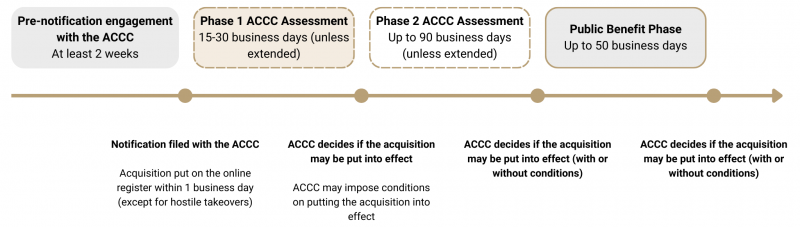
The timeframes stated in the diagram above can be extended by the ACCC in various circumstances – for example, if the ACCC requires further information.
As noted above, the ACCC will aim to make approximately 80% of decisions within 15-20 business days.
However, even after approval by the ACCC, the parties must wait 14 days before proceeding with the deal. This is in case any third parties wish to apply to the Tribunal to try to stop the deal.
The ACCC recommends that parties engage with it at least 2 weeks before notification. This is intended to help ensure that a notification has the information required by the ACCC – otherwise the ACCC may determine the notification was not effective (potentially some time after attempted notification occurred).
Once effective notification has been made, Phase 1 is intended to be an initial assessment by the ACCC of any competition concerns.
The ACCC can allow a deal to progress to Phase 2 if the ACCC considers the deal could have the effect or likely effect of substantially lessening competition in any market. This is a low bar, however, the ACCC has indicated that it expects relatively few deals to progress to Phase 2.
The fees for Phase 2 are significantly higher than for Phase 1 (see above).
After Phase 2, if the ACCC has not approved the deal, the parties may apply for a public benefit assessment (see below).
| Waiver applications: The statutory decision timeframe is 25 business days. The ACCC aims to make approximately 80% of decisions within 15-20 business days. |
Public register and confidentiality
The ACCC makes information about merger notifications public on an online notification register, located here.
The register is generally updated within one business day of notification.
There is an exception for surprise hostile takeovers. The ACCC generally must not put information about a surprise hostile takeover on the register until the 17th business day after
notification.
Waiver applications are included on the register one business day after the ACCC’s decision whether to grant the waiver (with the exception of surprise hostile takeovers, discussed further below).
The register contains basic details of the deal and the ACCC’s progress in assessing the deal, not full copies of the notification or transaction documents.
However, it is important to claim confidentiality over any confidential information provided to the ACCC as part of a notification or waiver application.
“Goodwill protection provisions”
Business/share sale contracts commonly include a restraint that prohibits the seller, for a period of time and in certain locations, from competing against the business the seller has just sold.
These restraints are designed to protect the goodwill of the business that has been sold. Previously, they were permitted as an exception to the competition laws, including the cartel laws, if the restraint was solely for the protection of the purchaser in respect of the business’ goodwill.
Under the new merger laws if a notified deal includes this type of restraint, the ACCC can declare that the exception does not apply to the restraint.
To make such a declaration, the ACCC must be satisfied that the restraint is not necessary for the protection of the purchaser in respect of the goodwill of the business. This could be, for example, if the ACCC considers that the duration and/or geographic scope of the restraint is broader than necessary.
If the ACCC does not make a declaration, it can still take enforcement action regarding the restraint at a later date. This could be on the basis that the restraint is excessive, is not solely for the protection of goodwill, and so does not fall within the current exception.
Public benefit
Even if the ACCC considers that a deal would substantially lessen competition, the ACCC can still allow the deal to proceed if it is satisfied that the public benefit resulting from the deal outweighs the public detriment.
The ACCC may impose conditions as part of its decision to allow a deal to proceed on public benefit grounds.
A party can only apply for a deal to be approved on public benefit grounds after the ACCC has made its determination on whether there is likely to be a substantial lessening of competition.
There is a prescribed form and an additional fee of $401,000 for public benefit applications.
Takeovers
Notifications generally
Takeover acquisitions can be notified to the ACCC, even if no contract has been entered into and all the parties don’t intend to enter into one (which is usually required).
This applies to acquisitions resulting from the acceptance of a takeover bid, and acquisitions by the bidder during the bid period resulting from on-market transactions.
The bid must have been publicly proposed, the bid must have been made, or it’s a surprise hostile takeover.
Notification of a surprise hostile takeover
If it’s a surprise hostile takeover:
- the bid must satisfy certain conditions including that it is for all the voting shares in the bid class (a “full bid”);
- the bidder needs to make a request to the ACCC for confidentiality at the time of notification;
- the bidder must agree to give a bidder’s statement to the target within 1 business day after the ACCC approves the acquisition (without conducting a Phase 2 review);
- the ACCC must not include information about the notification on the acquisition register until the 17th business day after the effective notification date.
Further, if the ACCC approves the acquisition, the acquisition is not stayed during the period in which someone can apply to the Tribunal for review of the ACCC’s decision, until the bidder becomes aware (or ought to reasonably become aware) that someone has applied to the Tribunal, but:
- there may be restrictions on the exercise of voting rights attaching to the acquired shares; and
- the acquirer must dispose of the shares if the Tribunal disapproves the acquisition.
In certain circumstances, the ACCC may determine that these provisions do not apply.
Waiver applications
A bidder who makes a waiver application for a surprise hostile takeover may request the ACCC that the waiver application be kept confidential for a period.
The bidder must give a bidder’s statement to the ACCC and the target within 5 business days after the ACCC’s decision on the waiver application.
The bidder must also notify the ACCC within 1 business day of the bid being publicly proposed.
The ACCC must not include information on the acquisitions register for a notification waiver application before receiving the bidder’s statement. It must do so within 2 business days after receiving the bidder’s statement.
In certain circumstances, the ACCC may determine that these provisions do not apply to an application.
Review of ACCC decisions
Australian Competition Tribunal
A determination by the ACCC that a deal may be put into effect, or must not be put into effect, is subject to a limited form of review, known as “merits review”, by the Australian Competition Tribunal.
Some other decisions by the ACCC, such as whether a notification was effective, may also be reviewed by the Tribunal. An ACCC decision to proceed from Phase 1 to Phase 2 cannot be reviewed by the Tribunal.
The Tribunal will be composed of a panel of three members, one of whom is a Justice of the Federal Court of Australia.
Merits review by the Tribunal is not a full re-hearing. There is limited scope for new evidence and information before the Tribunal.
The Tribunal may affirm, set aside or vary the ACCC’s determination.
An application for review can be made to the Tribunal by the party who notified the deal to the ACCC. The Tribunal may also allow another person to apply for review, having regard to the person’s interest in the matter.
It is therefore possible that, even after the ACCC has decided that a deal may go ahead, a customer, supplier or competitor who opposes the deal may apply for the Tribunal to review the ACCC’s decision.
Applications to the Tribunal must be made within 14 calendar days after the ACCC’s reasons are published.
The Tribunal has 90 days to make its decision (subject to extensions).
If a deal’s market value or consideration (whichever is greater) is at least $50 million, the fee for a Tribunal review is 0.12% of that market value or consideration, up to $2.95 million (adjusted annually based on the ABS GDP implicit price deflator value). If the ACCC’s decision is set aside, you only get a 25% refund of the fee.
Internal reviewApart from review by the Tribunal, the notifying parties can seek an internal review by the ACCC of certain ACCC decisions. This does not include the ACCC’s decision whether a deal may be put into effect. An application for an internal review must be made within 7 days of the decision. |
Judicial reviewIt may also be possible to seek judicial review by the Federal Court of ACCC decisions. However, judicial review is concerned with the legality of a decision, not the merits. Further, the ACCC’s decision that a notification is subject to a Phase 2 review cannot be subject to judicial review under federal legislation. |
What businesses should do now
Consider whether any of your deals need to be notified to the ACCC.
- Do the notification thresholds and exceptions apply?
- Do you need information from the other party to decide?
- Should you apply for a waiver?
- Should you notify voluntarily, even if your deal is under the notification thresholds?
The new merger laws also have implications for drafting any contracts, including:
- the need for a condition precedent based on ACCC approval;
- responsibility for paying ACCC fees; and
- the risk of the ACCC declaring that a goodwill protection restraint is unnecessary.
Businesses should also factor in the heightened risk to deal completion arising from:
- the ACCC’s new power as the primary legal decision-maker (not the courts) based on whether the ACCC is satisfied there is likely to be a substantial lessening of competition;
- additional transparency and publicity for deals that are notified;
- potentially longer timeframes before a deal can be completed;
- you can’t notify the ACCC until a contract is signed (or all parties intend to);
- active opposition to the deal by third parties as part of the ACCC’s assessment process; and
- the prohibition on pre-completion integration if it amounts to putting the deal into effect.
You may also need to consider how your ACCC notification will interact with a notification to the Foreign Investment Review Board (FIRB), if required.
Setting a strategy to deal with these issues and getting the right advice to help you do that will be critical to getting the deal done and avoiding the severe consequences of not complying with the new merger laws.
For further information
Arnold Bloch Leibler’s competition team can help you navigate the new merger laws by advising on notification requirements and managing the notification process.


This guide was prepared by Matthew Lees (Partner) and Aaron Bronitt (Lawyer).
Disclaimer
The information in this guide is intended only to provide a general overview of matters of interest. The information does not constitute legal advice. As the law is continually evolving, the information may not be definitive or up-to-date. Any use that you may make of the information on this site is not intended to create, and your use does not constitute, a solicitor/client relationship. Professional advice should be obtained from a duly qualified person before taking any action in relation any of the information contained in this guide. Please contact us if you require our assistance.
Copyright
Unless otherwise indicated, copyright in the information on this site is owned by Arnold Bloch Leibler. If you wish to reproduce any of the information in this guide, please contact us and obtain our permission before doing so.